
In this article
AEO (answer engine optimisation) means getting AI assistants such as ChatGPT, Gemini, Claude and Google AI Mode to use your information in their answers and recommend you to the person asking. For hospitals and clinics, it means making it clear to AI what you offer, what it costs, who your doctors are, where you are, when you are open and which insurers you accept, so it is confident enough to recommend you.
It is sometimes called GEO (generative engine optimisation); they mean the same thing. The difference from SEO is that classic Google shows ten links for the patient to choose from, while AI assistants summarise and recommend only a few providers. A provider without clear information does not sit at the bottom of the list; it is missing from the answer. This guide explains how AI chooses providers, what to do and how to measure it, with a tracker and a free report.
How AI chooses which providers to recommend
AI assistants do not keep a list of the best providers; they build answers from what they can find at the time, especially with web search on, which every major assistant uses for questions about places and prices.
| Source | What AI takes from it | What to do |
|---|---|---|
| Your website | Services, prices, doctors, hours, location, FAQs | A page per service, readable text and structured data |
| Google Business Profile and Maps | Name, location, hours, categories, reviews | Complete details matching your site; reply to every review |
| Reviews | Service quality from patients’ view | Ask for reviews consistently |
| Platforms where you sell, such as HDmall | Packages, prices, inclusions and reviews | Complete package details matching your site |
| Online communities and news | Other people’s experiences and recommendations | See what is said about you; publish accurate facts on your site |
Trust comes from several sources agreeing. If your website says you open until 8 pm, Google Maps says 6 pm and a platform shows another price, AI tends to recommend someone whose facts are clearer.
How AEO differs from SEO
| SEO | AEO | |
|---|---|---|
| Goal | Rank in search results | Be used and recommended in AI answers |
| What users see | A list of links to choose from | A summary recommending a few providers |
| What matters | Keywords, pages, links from other sites | Clear facts, consistent across sources, easy to read |
| Relationship | The foundation | Built on the same foundation |
AEO does not replace SEO. Ahrefs found in February 2026 that Google sends about 40% of external website traffic against about 0.2% from ChatGPT, and Google’s AI Overviews and AI Mode build answers from Google’s own index. Pages Google can find and understand are the foundation of both.
The 10-point AEO checklist
HDmall’s website health check report uses this same list to score readiness for AI assistants. Passing 8 or more means ready; fewer than 5 means AI has almost no reliable information about you.
| Item | Why it matters |
|---|---|
| 1. AI assistants’ crawlers can read the site | If blocked, AI cannot answer patients about you at all |
| 2. Machine-readable facility information (schema) | Tells Google and AI directly who you are and where |
| 3. Machine-readable opening hours | AI can say whether you are open now |
| 4. Machine-readable doctor information | AI uses doctor profiles to judge trust |
| 5. FAQs on the website | Patients ask AI questions; pages that answer them get picked |
| 6. FAQs in machine-readable form (FAQ schema) | Your answers can be used directly |
| 7. An llms.txt file | Summarises the facility for AI in one file |
| 8. Markdown (.md) versions of pages | Plain-text versions AI reads faster and more accurately |
| 9. Prices as text | Price is the question patients ask AI most |
| 10. Enough text content | AI cannot read text inside images |
The details of each follow. Several of items 1–7 can be fixed straight away with our free AEO tools, which create llms.txt, generate schema code and check AI crawlers.
1. Let AI assistants’ crawlers read your site
Your site’s robots.txt says which crawlers may read it. AI assistants have two kinds: one searches and answers patients in real time, which you should always allow; the other collects data to train AI, which you can allow or block as a matter of policy.
| System | Crawler for search and answers | Crawler for training |
|---|---|---|
| Google Search, AI Overviews and AI Mode | Googlebot | None separate |
| Gemini | Uses Google’s data, with extra control via Google-Extended | Google-Extended |
| ChatGPT | OAI-SearchBot, ChatGPT-User | GPTBot |
| Claude | Claude-SearchBot, Claude-User | ClaudeBot |
| Perplexity | PerplexityBot, Perplexity-User | None separate |
| Bing and Microsoft Copilot | Bingbot | None separate |
| Apple (Siri, Apple Intelligence) | Applebot | Applebot-Extended |
Check your site’s security settings too: aggressive bot protection sometimes blocks these crawlers without anyone noticing.
2. Structured data (schema) for the facility, doctors and hours
Structured data is code on the page that tells machines what each piece of information is, using the schema.org standard. Include:
- The facility, as Hospital, MedicalClinic or Dentist, with name, address, phone and coordinates
- Opening hours, with days, times and special holidays, so AI can say whether you are open now
- Doctors, as Physician, with name, specialty and where they practise
- Services, with each main service and its page
These must match the text people see on the page and on your Google Business Profile.
3. FAQs and FAQ schema
Patients ask AI full questions, such as which insurers you accept or whether to fast before a check-up. Pages with the same questions and short, direct answers are more likely to be used. Write questions the way patients ask them, answer in the first sentence, and add FAQ schema so machines know which parts are questions and answers.
4. An llms.txt file
llms.txt is a short text file on your site, such as yourclinic.com/llms.txt, written for AI assistants. It summarises who the facility is, its services, prices, location, hours and how to book, with links to key pages. Just as robots.txt says what crawlers may read, llms.txt says which information matters most.
# Example Dental Clinic
> Dental clinic near BTS Ari, Bangkok

## Services and prices
- Scaling and polishing: THB 900
- Clear aligners: from THB 45,000

## Opening hours
- Daily 10:00–20:00

## Book
- https://yourclinic.com/booking
llms.txt was proposed in 2024 (llmstxt.org). Some AI assistants may not use it yet, but it is easy and almost free to add, so it is worth having.
5. Markdown (.md) versions of pages
Normal web pages mix content with menus, scripts and decoration. A Markdown version is the same page as plain text, which AI can read faster and more accurately. The usual approach is a .md file alongside each important page, announced in the page head with an alternate link of type text/markdown. This article has one too: add index.md to the end of its URL.
6. Prices and key facts as text, not images
Prices, promotions, awards and accreditations often live inside images, which Google and AI cannot read. Always put the same information on the page as text. Every service page should open with a sentence saying what the service is, its starting price and who it suits, followed by inclusions, preparation, recovery and the doctors.
7. Your own website, not just social media
AI assistants answer patients from what they can read on the web, but most social platforms block AI assistants’ crawlers from reading while they answer.
| Channel | Can AI assistants read it while answering? | Notes |
|---|---|---|
| Mostly not; blocks ChatGPT, Claude and Perplexity crawlers | Most content needs a login | |
| No | Most content needs a login | |
| TikTok | No | Information is in video, with little text |
| LINE (profile page) | Yes | Only the profile page; chats are private |
| Your own website | Yes | You control everything: prices, hours, doctors and information for AI |
Based on the HDmall team’s check of each platform’s robots.txt in October 2026, which may change. Keep using social media to talk to patients, but keep core information (prices, hours, doctors and booking) on your own website or mini-website.
8. Google Business Profile, reviews and booking
Google AI Mode and Gemini use Google Maps data directly, and AI assistants often cite reviews when recommending providers. A strong profile has a rating of 4.5 or more, 100 or more reviews, complete hours, details matching your website, and online booking.
- Consistent facts everywhere: name, address, phone, hours and prices must match on your website, Google Business Profile, social pages and the platforms you sell on, such as HDmall, which AI also draws on
- Reviews: ask every patient after treatment, not just happy ones, and never offer rewards for reviews, per Google’s policy. Timing matters: too early and patients have not seen results, too late and they forget the details. Reply to every review without disclosing treatment details
- Booking: make the Google booking button lead to your own booking page, connected to your real schedule; see Book Now and Google agentic health appointments
9. Multiple languages, if you serve international patients
International patients ask AI in their own language. With only Thai pages, AI has almost nothing to recommend. At minimum, have English pages for your main services.
10. Stay within advertising law
Website content inviting people to use your services still falls under Thailand’s hospital advertising law. The content AI prefers, clear facts, is what the law wants anyway: no exaggeration and no guaranteed results. See our healthcare advertising guide.
Measure it: how often does AI recommend you?
The most direct measure of AEO is asking AI the questions patients actually ask and counting how often you are recommended, every month, with the same questions. That figure is your share of AI answers, and it should rise every quarter. Enter your name, area and main services below to start.
AI visibility tracker
Enter your hospital or clinic name, area and main services. The tool builds the questions patients actually ask AI. Open each in ChatGPT or Google AI Mode and tick whether the answer recommends you. Repeat monthly to see the trend. Results stay in this browser only.
Monthly history
AI answers vary with time, location and wording, so look at the monthly trend rather than any single answer, and ask from a logged-out or private browser window to reduce the effect of your own history.
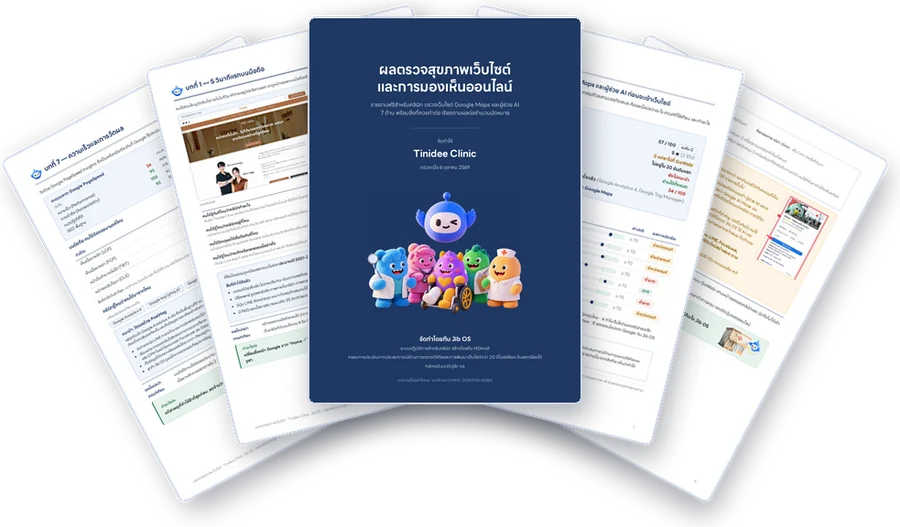
Let the HDmall team check your website and Google presence for free
The tracker above measures the AI answers; this report checks where those answers come from, your website and Google profile, and tells you what to fix first.
Free for clinics and hospitals
Get a free website and online visibility health check
Most patients find a clinic on Google Maps or through an AI assistant before they visit its website. See how yours shows up, and what to fix first, ranked by impact on bookings, in a PDF report sent to your inbox.
What we check
- Design and trust in the first 5 seconds
- Turning visitors into bookings
- Mobile experience
- Website speed
- Google search (SEO)
- Readiness for AI assistants, and whether ChatGPT recommends you
- Your Google Maps profile and Book online button
No website yet? You’ll get a shorter report on your Google Maps profile and AI visibility.
Your report is on its way
A 30-day plan to start
- Week 1: measure your baseline with the tracker in this guide, and request the free report
- Week 2: make facts match everywhere: website, Google Business Profile and the platforms you sell on
- Week 3: build or improve pages for three main services, with prices, inclusions, doctors and FAQs as text
- Week 4: add structured data, FAQ schema, an llms.txt file and .md page versions, check robots.txt and start asking for reviews systematically, then measure again next month
Frequently asked questions
What is AEO?
AEO (answer engine optimisation) means getting AI assistants such as ChatGPT, Gemini, Claude and Google AI Mode to use your information and recommend you. For hospitals and clinics, it means making clear what you offer, what it costs, who your doctors are, where you are and which insurers you accept.
What is the difference between AEO and GEO?
They mean the same thing: getting AI systems that generate answers to use your information and recommend you. AEO comes from "answer engine", GEO from "generative engine".
Do clinics need AEO if they already do SEO?
Yes, built on top of SEO, since they share a foundation. What to add: clear facts on your pages such as starting prices, inclusions, doctors and insurers accepted, consistent information everywhere, and monthly measurement by asking AI.
What is llms.txt?
llms.txt is a short text file on your website written for AI assistants, summarising who the facility is, its services, prices, location, hours and how to book, with links to key pages. It was proposed in 2024; some assistants may not use it yet, but it is easy and almost free to add.
How do .md versions of pages help AEO?
A Markdown version is the same page as plain text, without menus and scripts, so AI reads it faster and more accurately. Provide one for each important page and announce it in the page head with an alternate link of type text/markdown.
Can a clinic with only a Facebook page do AEO?
Only to a limited extent, because Facebook, Instagram and TikTok block most AI assistants’ crawlers from reading content while they answer. Have a website or mini-website with services, prices, doctors, hours and FAQs as text.
How do we know whether ChatGPT recommends our clinic?
Ask the questions patients actually ask for each service, such as where to get this service in your area, and count how often you are recommended. Repeat monthly with the same questions. The tracker in this guide builds the questions and keeps monthly scores.
How long until we see results?
It depends on your starting point. Fixing inconsistent information and adding clear service pages usually shows in search and AI answers within weeks to a few months, since systems need time to find the new information. Watch the monthly trend.
Sources
- Milan Novotny, ChatGPT vs Google search statistics 2026 (compiling Ahrefs, StatCounter and Similarweb data)
- Similarweb, AI Search Stats 2026
- HDmall, 15 healthcare marketing trends for 2027